HDFC, TCS, RIL, ITC and ICICI Bank dragged the Sensex by over 100 points.
Heavy unwinding by foreign portfolio investors and lacklustre equities dampened the sentiment

Officers sitting over untapped potential to make COVID-19 vaccines need to be charged with 'manslaughter' as it is leading to so many deaths, the Delhi high court said on Wednesday, observing that a lot of scope and infrastructure is available in India which is not being used.

The source said logistics became a big issue for almost all the participating countries.

Meanwhile, IT bucks trend; TCS, Tech Mahindra and Infosys from IT pack were up 0.2-1.3%.

Given the uncertainties around gold's future course, stagger your purchases and buy on declines, says Sanjay Kumar Singh.

'Increased allocations for MNREGA could have provided the much needed push to rural demand and consumption at a time when recovery continues to remain uneven.'

'It is going to be a tough balance for the RBI to manage economic stability and ensure smooth government borrowing.'

'If the Union Budget can provide incentives for animal spirits to come as well as induce demand stimulus and consumption, the Budget would have done a wonderful job.'

He said cheap valuations, improving sentiment and the ongoing reform momentum coupled with increased transparency due to the internet are driving investors to the Dalal Street.
Benchmark share indices opened lower on Monday, amid weak global cues, as investors turned cautious ahead of the US Federal Reserve stance on interest rate.
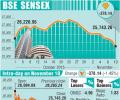
Markets will be open from 5.45 pm to 6.45 pm on Wednesday.
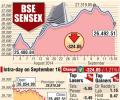
The 30-share Sensex ended down 324 points at 26,493 and the 50-share Nifty closed 109 points lower at 7,933.

As if wanting to be an antidote to the coronavirus pandemic, the Indian stock market adorned carnival robes in 2021 with a tsunami of liquidity unleashed by global central banks coupled with supportive domestic policies and the world's largest vaccination drive sparking off a world-beating rally on Dalal Street, despite bouts of uneasiness over fizzy valuations. While the wider economy shuttled between recovery and relapse, dictated by multiple mutations of the virus, equity market benchmarks appeared headed in just one direction -- skywards. The dizzying upward journey has added a whopping Rs 72 lakh crore during 2021 to investors' wealth, measured as the cumulative value of all listed shares in the country, taking it to nearly Rs 260 lakh crore.

Kejriwal's centralised way of governance might work in Delhi, but Punjab will call for delegation, observes Sanjeev Nayyar.

From its March 2020 low, Bitcoin has gained a massive 474 per cent and has surged 214 per cent year-to-date.

Since the beginning of 2020, i-bankers have collected nearly Rs 1,800 crore by way of IPO fees. Interestingly, the India fees this year form just 1 per cent of the global fee pool of $13.7 billion from IPOs.

Enrico Piperno, who was also India's Fed Cup coach says, lack of funding, support and infrastructure will cease creation of a top-50 player

Christopher Wood, global head of equity strategy at Jefferies reiterate his bullish view on Indian equities on the back of a steady fall in Covid cases coupled with a sharp economic recovery in India, reports Puneet Wadhwa.

'The first half of 2019 could be volatile.' 'In the second half, volatility inducing events should be largely behind us.'
On the Sensex chart, Axis Bank, Titan, IndusInd Bank, HDFC Bank, Dr Reddy's, HDFC and Asian Paint were major losers.
Led by the weak trend in the broader market, the market capitalisation of BSE-listed companies plunged Rs 1,65,437.91 crore to Rs 1,38,54,439.41 crore.

Indrani was spiritedly telegraphing details of the jewellery from the back of the court...
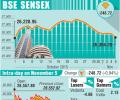
The 30-share Sensex ended down 249 points or 0.94% at 26,304 levels.

Frantic dollar demand from corporates along with an aggressive hedging strategy adopted by importers in the wake of the currency volatility predominately took a toll on the domestic unit despite moves by the central bank to stabilise the currency.

'I was feeling so suffocated under Yogiji's rule.'

FIIs pump in $1.4 billion in March, after pulling out $2.9 billion in Jan-Feb.
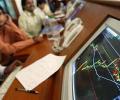
Engineering major BHEL rebounded from its day's lows to end around 1% higher.

This flight of capital began in early August due to risk-aversion created first by rising geopolitical tensions due to North Korean aggression and second by the US Fed's decision to shrink its balance sheet

From the 30-share Sensex pack, 23 scrips declined in Wednesday's session, led by IndusInd Bank, Bajaj Finance, Tata Motors and Tata Steel which fell by up to 3.87 per cent.
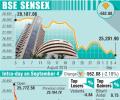
The 30-share Sensex ended down 563 points at 25,202.
'A strong foreign exchange reserve is the best safety net against global spillovers.'

On the 10th anniversary of the global financial crisis, a multi-part series analyses the lessons learnt and those not learnt.

'This looks like a long-term bear market and there could be mounting losses in the near-term,' says Devangshu Datta.

RBI will take a cue from the Fed policy statement.
However, volatility is likely to be on the rise, said Benjamin Yeo, MD & CIO (Asia & Middle-East) for Wealth & Investment Management, Barclays.

Reliance Industries was the top gainer in the Sensex pack, surging over 3 per cent, followed by Bajaj Finserv, IndusInd Bank, HDFC twins and Kotak Bank. NSE Nifty surged 143.25 points or 1.18 per cent to 12,263.55.
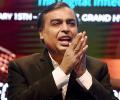
Billionaire Mukesh Ambani on Monday pressed for bridging the digital divide "both among nations and within nations", saying connectivity and communications have become the fundamental rights of every person. Also, there is a need to bring back the economies around the globe. Speaking at the Qatar Economic Forum, he said it is difficult to imagine what India would have been without the 4G telecom network during the pandemic. "The digital divide must be bridged, both among nations and within nations.

RBI awaits fiscal stance, inflation to cool off to decide on rates.

Like ants declining to question the rules of the anthill, they feel innately justified in their approach, notes Shyam G Menon.
 © 2026 Rediff.com - Advertise with us - Disclaimer - Privacy Policy - Sitemap - Feedback - About us - Terms of use - Grievances